Philly voting officials suggest mailing in ballots a week early this fall
Vote Early. Be Counted.
City officials warn of more delays in counting votes in November. Philly 3.0'south engagement director seconds their advice: Post in your ballots a week ahead.
Jul. 31, 2020


Pennsylvania'due south expanded vote-by-mail policies were a lifeline during the main in June. The rollout wasn't perfect, though, in ways officials and ballot observers are still piecing together, and last week The Inquirer added to that body of analysis with the alarming finding that as many as 92,000 Pennsylvania absentee voters may have been effectively disenfranchised by mundane logistical bug like postal delays.
Many voters applied for post-in ballots past the official deadline, but got them too belatedly to post them back with enough time for their vote to count in the election.
What the Inquirer analysis finds is that the closer to the May 26 deadline people applied, the more likely information technology was that they "didn't vote"—which could only mean their ballot wasn't counted because of how late information technology was received. Reporter Jonathan Lai explains the tendency:
Before May 12, about 90 pct of voters who requested mail ballots ultimately voted, and the vast majority did so by mail. But many post ballot applications, almost two out of 5, were processed within 3 weeks of the ballot. And for those voters, only most 76 per centum concluded up voting.
That'due south a pregnant difference: Without that drib-off, nearly 92,000 more than Pennsylvanians would have voted in the primary, according to the Inquirer analysis […]
To get a wider picture of voter beliefs, The Inquirer combined a dataset of every approved mail election request for the June 2 primary ballot with the July xiii voter roll, which records the method by which a voter participated in the master election. (Two counties, Northumberland and Susquehanna, were excluded from the analysis considering they did not have data for the primary.) Of the more than 1.8 million voters in the assay, i.09 million had their applications processed earlier May 12 and almost 976,000 of them concluded up voting. More than than 713,000 voters had their mail ballot requests processed on or later May 12, and 545,000 of them ultimately voted.
Thursday afternoon on Twitter, Urban center Commissioner Lisa Deeley confirmed that voters should expect more mail service delays in Nov and that they should plan appropriately when voting absentee.
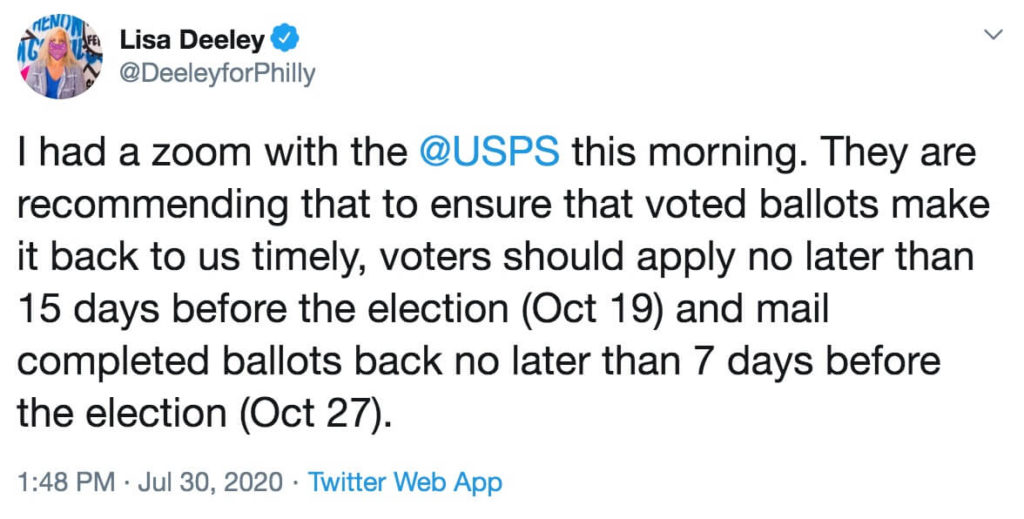
This is why information technology's so of import that everyone who is able to do then request a mail-in ballot correct now, as soon as possible, so that the city commissioners can process them while demand is low, and get people their mail ballots quickly.
Pennsylvanians can begin voting in just 45 days thanks to Act 77.
The sooner that voters submit the applications, and the sooner they complete and return the ballots, the easier and faster it will be for the commissioners to tabulate the votes on Ballot Day—especially if state-level legislative changes are made to permit election officials to begin processing, but not scanning, absentee ballots earlier Election Day.
THIS ARTICLE IS Function OF A CONTENT PARTNERSHIP WITH:

The processing part is what took the longest after the June 2 chief, and in one case the ballots were processed, the scanning and vote counting went very chop-chop. There'due south a very short window in August for the state legislature to act, and whatsoever law would demand to be passed by early on September at the latest.
 A few other storylines from this week help underscore how gravely serious the mail-voting outcome is, and the consequences of failing to improve on the process for the full general ballot.
A Trump campaign donor is now in accuse of the U.S. Postal Service and has been making eyebrow-raising toll-cut measures that are causing days-long postal service backups across the country.
It might sound a fiddling too conspiratorial to say they're conveying out intentional sabotage of state mail voting systems if the president wasn't likewise out in that location this week aggressively hinting that's what he'south trying to exercise.
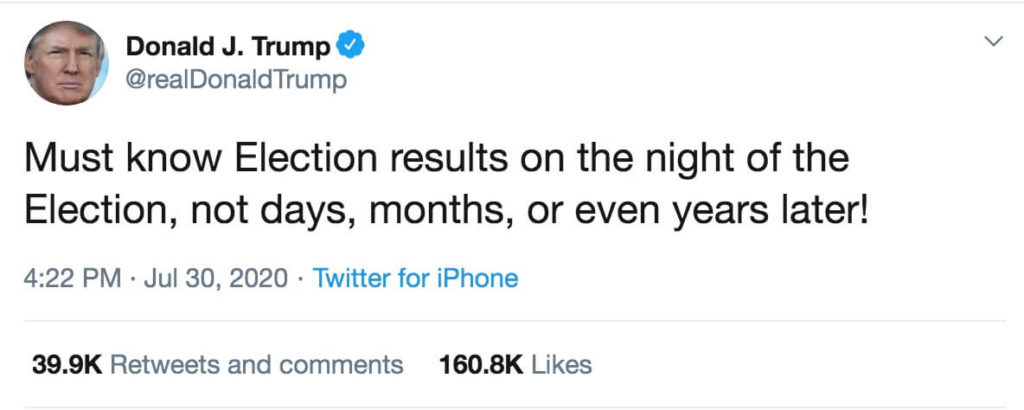
In add-on to calling for a delay of the election—an act that, thankfully, would require a vote by Congress—the president also tweeted that the election night vote tally must wrap up on election dark, conspicuously wish-casting the Pennsylvania nightmare scenario.
In that location hasn't historically been a partisan skew to mail voting, simply due to President Trump's fraudulent attacks on the legitimacy and security of voting by mail, it'south get more polarized along party lines, with registered Democrats telling pollsters they'll vote absentee at higher rates than registered Republicans this fall.
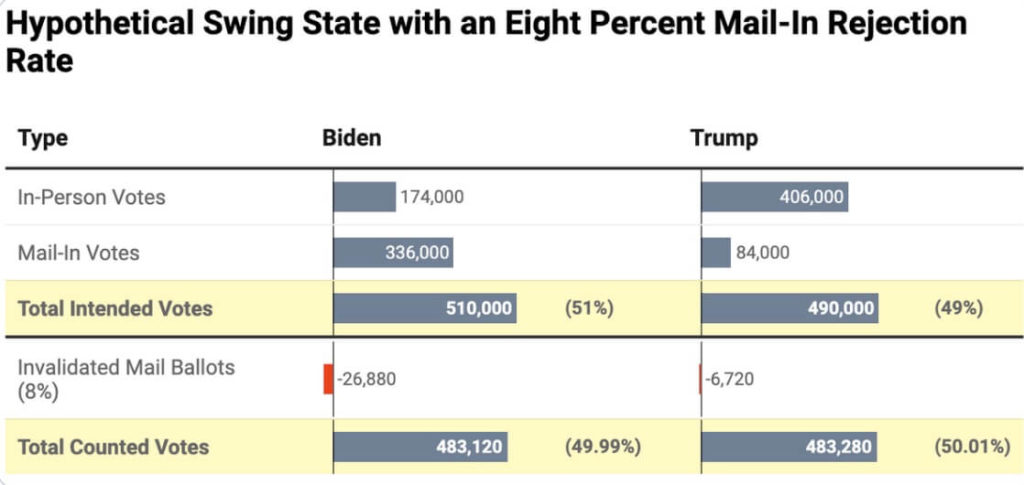
This is where a loftier absentee ballot rejection charge per unit could brainstorm to affect the results. The worst of the worst, New York country, astonishes with an absentee ballot rejection charge per unit of near 20 percent, but it doesn't need to be quite that bad to brand a deviation.
An example offered by Cook Political Report shows that, due to an asymmetric polarization of postal service voting, an 8-percent rejection charge per unit for absentee ballots could be plenty to shift the result from a Biden win to a Trump win.
In the Philadelphia chief in June, the absentee election rejection rate was much lower, at 3.8 percent, only nosotros still don't know what the statewide figure was.
Add in the specter of loftier-contour litigation looming over all this, and a film starts to form of how thousands of well-meaning people abiding by the land's official deadlines could nonetheless be disenfranchised in November if no further changes are made.
We also learned more than this week nigh who is participating in mail-in voting in Philadelphia. As it turns out, education is the biggest determinant.
Political analysts are nevertheless poring over the Pennsylvania primary results—specially the absentee voting patterns and some of the observed differences in which demographic groups chose to vote by mail or non.
 The narrative so far has been that in Philadelphia, whiter, college-income precincts voted past mail at high rates, while primarily Blackness precincts had much lower rates of postal service voting, while in some places partly or by and large making up for it with high-for-a-primary rates of in-person voting.
AFL-CIO Data Managing director Mike Johnson shared a new analysis on Twitter excavation deeper into this, and what he found was that the biggest predictor was not race, but didactics level.
Having a Available's degree accounts for about 68 percent of the variation in vote-past-post usage, and usage is even more tightly correlated with having a more advanced degree.
And while educational attainment does correlate with race and poverty to some extent, race or income levels lonely don't offer much predictive value.
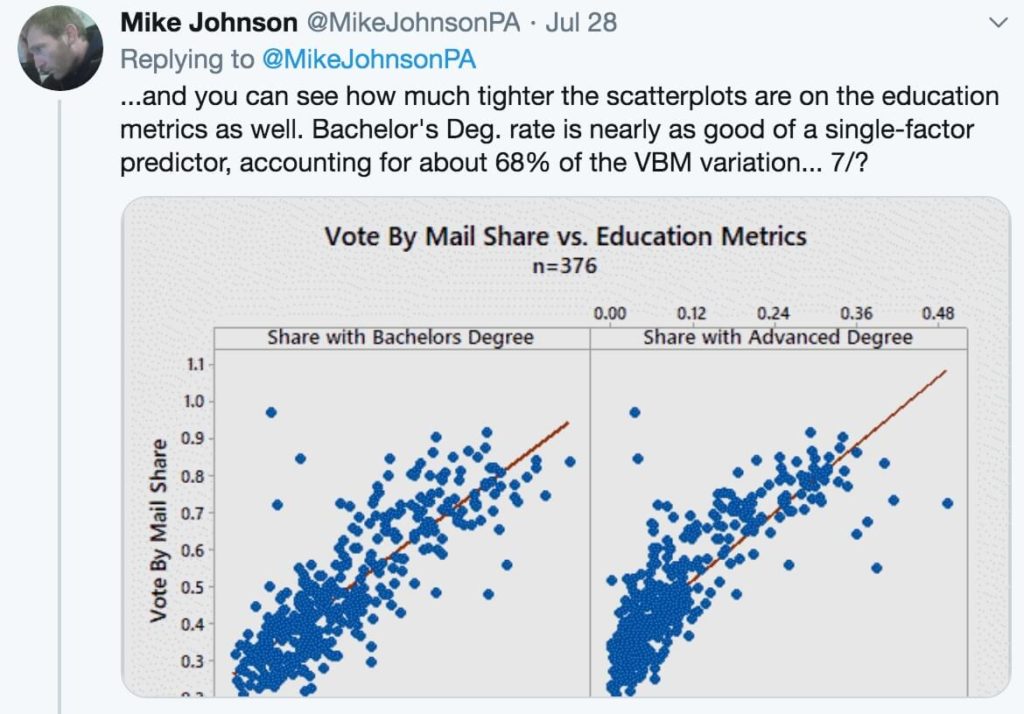
It's a subtle but important insight for everybody trying to figure out where there is withal the well-nigh discomfort with vote-past-mail, and what can be done to increase people'south trust and comfort levels with the process, which volition remain the safest voting choice come Nov.
Want more local 2022 election news? Swoop into these related pieces:
Jon Geeting is the managing director of engagement at Philadelphia 3.0 , a political action commission that supports efforts to reform and modernize Metropolis Hall. This is part of a serial of articles running on both The Citizen and 3.0's blog .
Header photo by Michael Sheehan / Flickr 
Source: https://thephiladelphiacitizen.org/mail-in-ballots-philadelphia-early/
0 Response to "Philly voting officials suggest mailing in ballots a week early this fall"
Publicar un comentario