Where to Do You Store Art Projects Art Teacher

viii Tips to Setting Upwardly Your Art Room
Hi friends! Outset off I desire to starting time off by saying welcome to ArtwithMrsE.com! Wow, I can't believe I'g proverb that!
When I started documenting my adventures in fine art education on Instagram back in 2013, I never thought it would lead to such amazing opportunities to connect with so many incredible art teachers, parents, artists, and just anyone who values the arts in their life. I am very excited to begin this next journeying into the blogging globe and look forrard to sharing lesson ideas, fine art instructor tips, and tricks, my art, you name information technology!
The next thing I'd like to say to any brand new art teachers out there: CONGRATULATIONS!! This is such an exciting fourth dimension for you! At that place is cipher like the excitement of walking into your very own classroom/ teaching space for the first time. Whether you are in a traditional classroom, on a cart, or somewhere in between, this is however a very heady time for you! But it likewise can feel very overwhelming. 14 years ago I walked into my very start fine art room, full of so much excitement but likewise feeling totally overwhelmed wondering where to even begin!? My walls were bare and yet my students were arriving in three days! So if you are feeling overwhelmed almost setting up your art room, I want to help! I will walk you through all of the things you lot need to know in order to feel prepared and confident going into the school year equally an fine art teacher.
1. Requite Yourself Grace
Ok, now read that over again. I'm serious. If you are a make new instructor or a teacher new to the field of art ed, or heck any teacher feeling overwhelmed at the outset of the school twelvemonth, please know that you are non alone. Many teachers, even veteran teachers, feel completely overwhelmed and stressed out and like in that location is never enough time at the start of the year. If y'all accept to scrap something considering yous feel like it just isn't working- then practice it. If you feel similar you are non beingness true to yourself as a person or teacher, so modify your course of action. Students thrive when their teacher is happy and excited almost being with them every mean solar day. Nothing is worth the cost of your mental health so stay truthful to yourself and know that no i is perfect their starting time year (or heck showtime 15 years into pedagogy.)
2. Beginning with your floor plan/classroom layout.
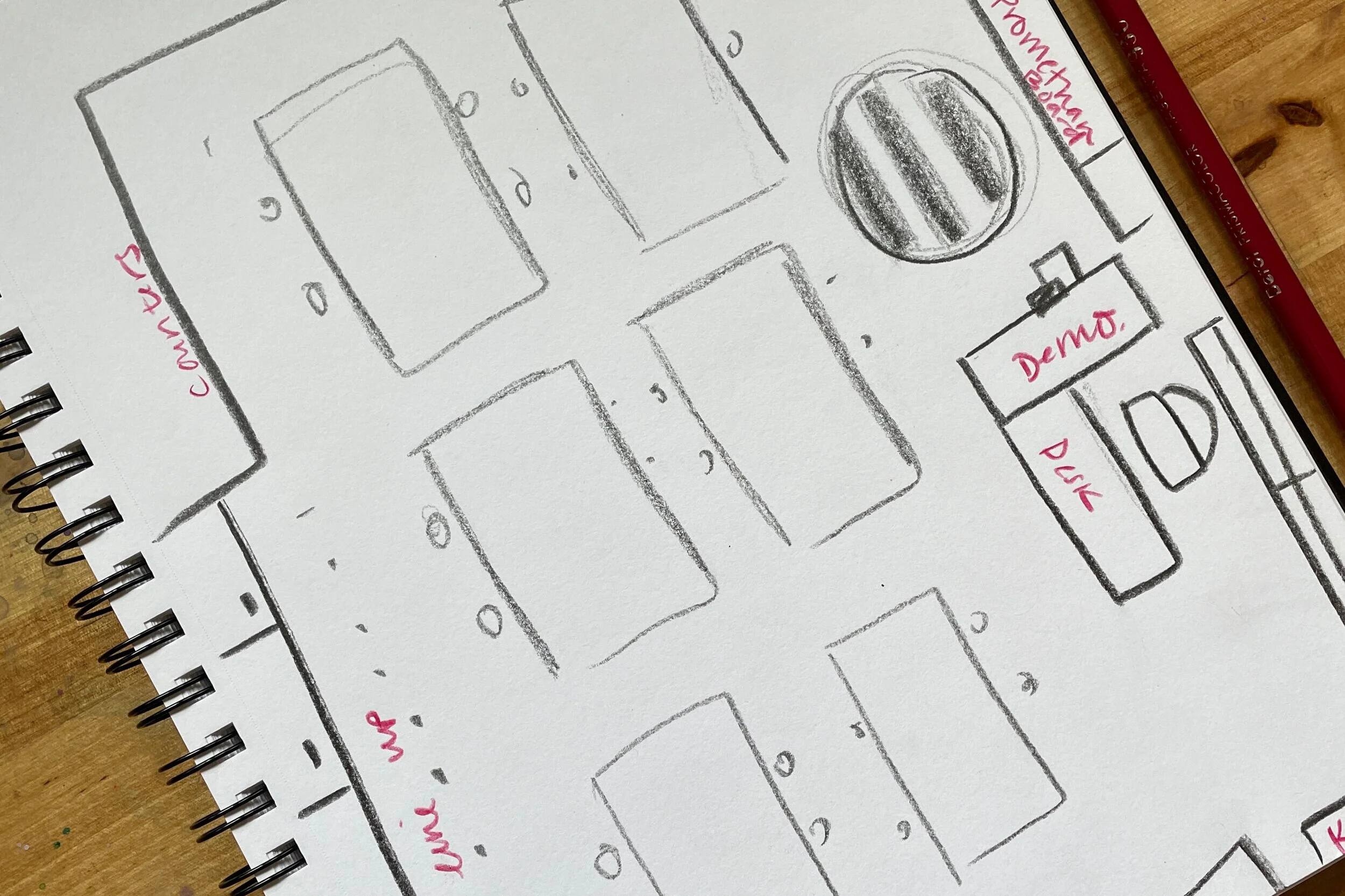
Being a visual person I first demand to see how my classroom layout is going to look earlier I start moving or organizing anything. In a sketchbook or just a plainly canvass of paper, sketch out the classroom layout yous are envisioning. Things to consider: Where is your demo infinite/ front of the classroom? What is the all-time table arrangement for student engagement/ student behavior? Pods or a U shape? Will any students have their backs to you while you are teaching? Will you take a carpet or maker space that you demand to plan for? How exercise y'all envision your students entering the room, where do they come in? How do they walk to their seats? Where do they line upwards to identify their art on the drying rack? Is everything safe in those areas? Once you have the menstruation and layout of your room nailed downwards, recruit a custodian or coworker to aid yous move your tables and furniture to come across the needs of your students and cocky.
3. Develop Your Classroom Management Arrangement
Classroom management is so of import when it comes to setting both you lot and your students upwardly for success at the kickoff of the school year. And then spend some time really working on a solid classroom management plan. Create a list of expectations or rules that you would like your students to agree to, or perhaps fifty-fifty plan on collaborating with your students the first day to create some expectations together. How will yous ensure that students follow these rules? Do you have a specific listing of consequences that you will follow in the event a student breaks a rule? Children need things spelled out in black and white- there cannot be whatsoever gray areas. "If I choose to do ______ then ______ will happen". This goes for both positive and negative reinforcement. For the record, I believe that positive reinforcement is incredibly effective and at that place are so many easy and cheap means yous can reward your students for doing the right matter. One of my favorites is application an "art star" at the end of each class. That student was my function model of the twenty-four hours, they earn a sticker and then get to be my helper the post-obit fine art class. It works wonders! Whatever system you settle on, don't forget to create visuals that you tin display clearly for your students to aid guide them to success.
iv. Student Artwork Organization
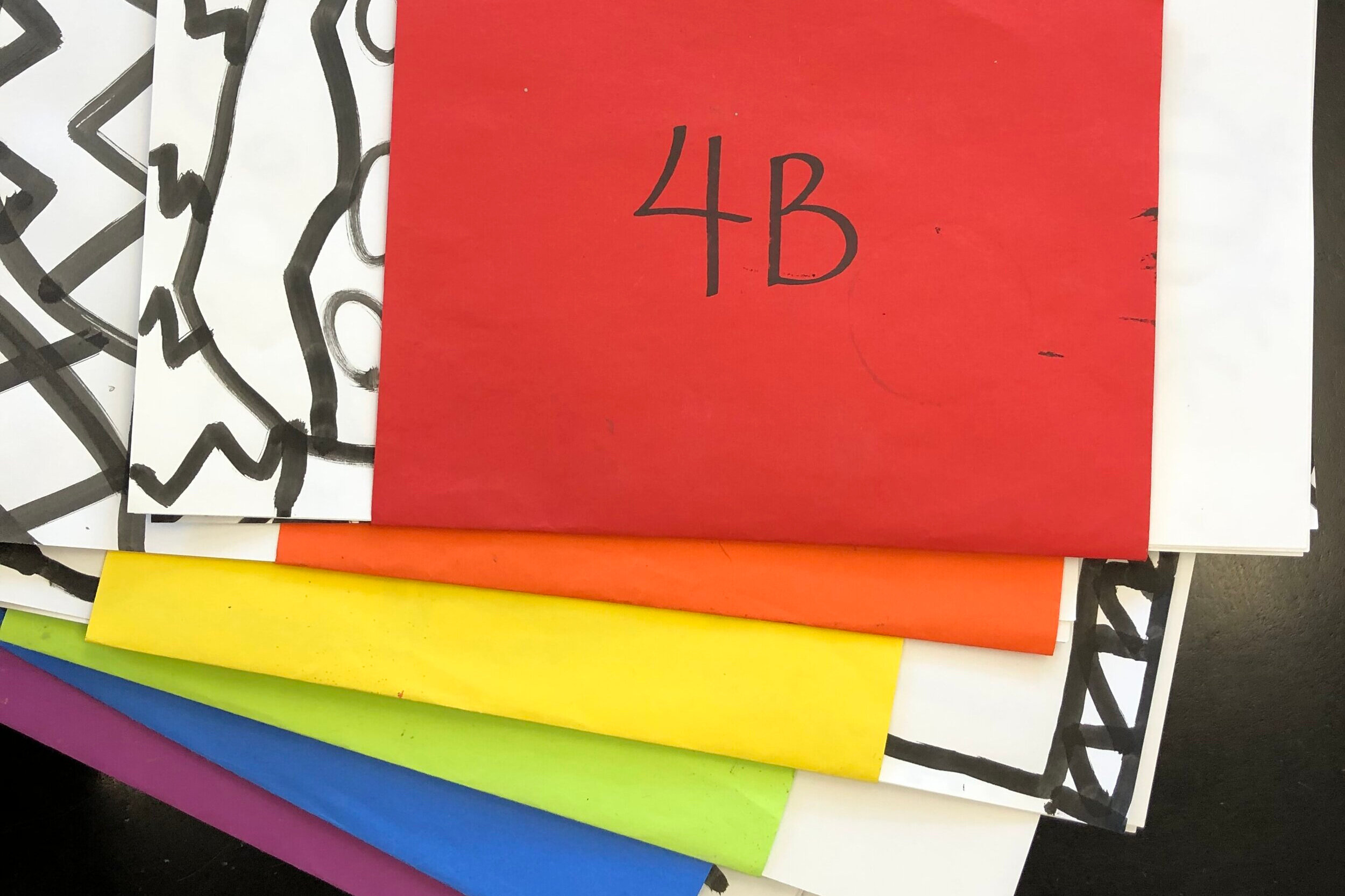
As the art teacher, you lot are going to be responsible for most likely hundreds of pieces of student piece of work- and every bit any veteran teacher will tell you, there is null worse than discovering that you have accidentally misplaced fifty-fifty one piece of art from a student :( And so you have to effigy out a system to help yourself stay organized. Showtime- survey the scene. Does your art room/ teaching space take an obvious spot that is designed for storing student artwork? For example, I am very lucky to take inherited an art room that has large flat pull-out drawers designed for student work. I have one drawer for each teacher's class. I know I am VERY lucky to take this set up upward-but don't worry, I have taught in 4 other schools prior to my current placement and none had such luxurious drawers. So what hacks did I come up with? Well, one of my favorite ways to organize educatee work was to create behemothic classroom folders. I created a large binder for each class I taught which was but two pieces of poster board, stapled or taped around the sides and bottom, and labeled in the peak corner with the course code or instructor name. Once those grade folders are made, they can be stacked on open shelving or slid into vertical cabinets. In one school I taught in, I was in a mobile classroom with very express storage so I just slid each folder into the top section of my drying rack and that's where they lived. In another school, I taught art in a cafeteria and auditorium and concluded up sandwiching them in between a cabinet and the wall. The moral of the story is- practice what works all-time for your teaching circumstances and your space. While we are talking nigh classroom folders- one of the best fine art teacher hacks I learned from a veteran instructor was to create smaller "table folders" that slide within the larger class folders. About fine art teachers label or identify the tables in their classroom in some way: whether they are by color, by number, by famous creative person- you name information technology. However you lot label your tables, you lot as well characterization your mini folders that match the tables. Do y'all have to go out and buy fancy table folders? No way. I just have 12 x 18 construction newspaper, fold it in half and write the class lawmaking on summit. I apply colors to organize my tables and so I take ruby, orange, yellow, green, blueish, and violet tabular array folders all with the class code on top, and they are then placed in the larger class folder or drawer. The reason why table folders are such a fourth dimension saver is that at the terminate of class all of the students at that tabular array identify their artwork in the table folder, close information technology up, and then all y'all have to exercise is go around and collect eight tabular array folders to store in your class folder vs. collecting private student artwork and fifty-fifty meliorate- the adjacent form you just pass out those table folders and it takes 3 seconds vs. passing out 25 individual pieces of artwork.
5 . Art Material Storage and Organization.
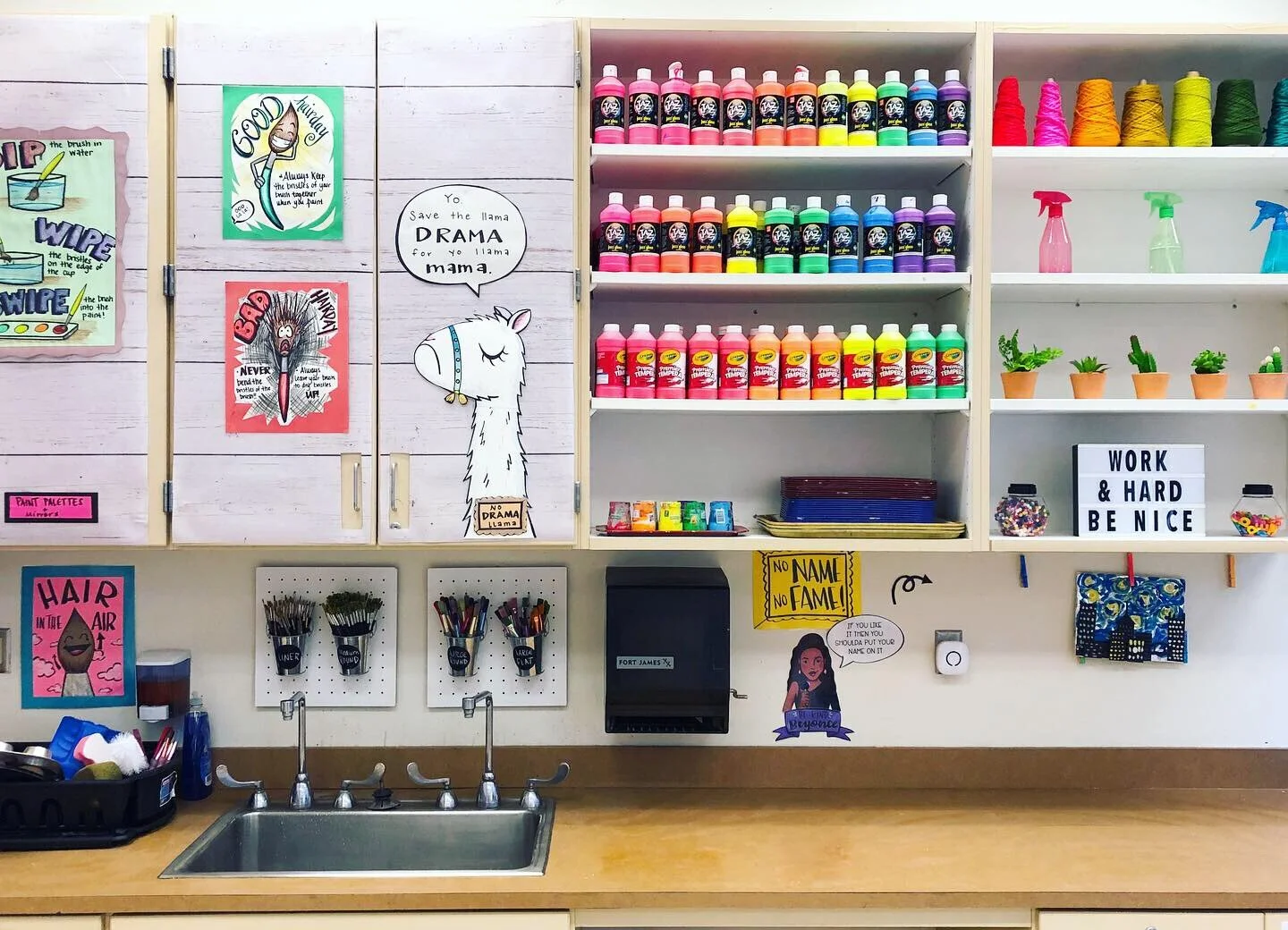
Art teacher= keeper of all the fun stuff, am I right?? Yet 1 of the biggest tasks every bit a new art teacher is figuring out a supply system that works for you and your students. No lie, this can be daunting but like anything, just take a bite i piece at a time. Outset matter's first: what is your storage situation? Practise y'all have cabinets? A storage room? Open up shelving? Anything at all? If you are a teacher on a cart so plain your art supply organization/ distribution is going to be much dissimilar than a teacher who doesn't leave their space. In your example, one could presume that you at to the lowest degree accept a "home base"/ storage room where your materials live when they are non traveling with you. But for the sake of this topic, let's assume you lot have a storage room and some cabinets. Commencement, yous need to decide what supplies practice you envision your students using the MOST. For me, those are oil pastels, construction newspaper crayons, sharpie markers, washable markers, and any and all types of paint. Make sure that those materials are stored somewhere that is easily accessible to yous, as you will be using them often. Personally, I proceed almost all of my art supplies in my storage room, with the exception of my paint and clay supplies. I have my most usually used supplies stored in the first cavalcade of shelving at eye level equally yous walk into my storage room so I can take hold of them speedily. Materials that I just use once or twice for specific lessons are stored and organized by medium deeper in my storage room. Supplies I rarely employ are kept on higher shelves every bit I don't accept the demand to admission them on a daily basis. For my paint supplies, I make sure to keep them stored above my counters and near my sink and so that I am able to layout my palettes and paint trays for distribution. I keep water cups and individual paint cups also above my sink for quick grab-and-go accessibility. Something else you lot may want to consider is: Do you want whatsoever of your materials to be also part of your decor? Significant- if you take open shelving, take you considered displaying your supplies in an aesthetically pleasing mode that is both serving the purpose of form and function. For example, I have chosen to take off the cabinet doors to a few of my cabinets specifically for the purpose of displaying some of my supplies to excite my students near beingness in fine art. If you don't follow Bar Rucci over at Fine art Bar Blog, I HIGHLY recommend heading to her weblog, IG, and checking out her books. One of the best tips I always read from her was to create a space that excites children to desire to create fine art. Display your materials in ways that are aesthetically pleasing: similar sorting materials past colour, or displaying smaller supplies in clear jars or bins so that students are excited to create when they see those materials. I chose to comprehend Bar's advice by displaying my fluorescent paints in open shelving, arranged in color gild. Besides displaying my paintbrushes in matching labeled tins with easy accessibility. Another thing to consider is labeling where your materials are. This is where supply labels volition exist super helpful! Not just are labels great for you, but they will aid anyone else who is in your room assisting y'all, whether information technology'due south a substitute, student helper, parent helped, co-teacher y'all name it! I created these art supply labels that have been incredibly helpful because non only are they labeled with the word, but likewise at that place is an analogy of the supply. These are besides great for ESL students to have the visual representation of the supply. You can place these on the bins where the supplies are, or on whatsoever cabinets or shelving where that supply is being stored. Yous may also want to consider if you will be leaving a caddie of specific supplies on each tabular array and what yous think makes the most sense to go in in that location, and also having each space labeled so students know exactly where to return their supplies.
half-dozen. Create a Warm and Inviting Space.
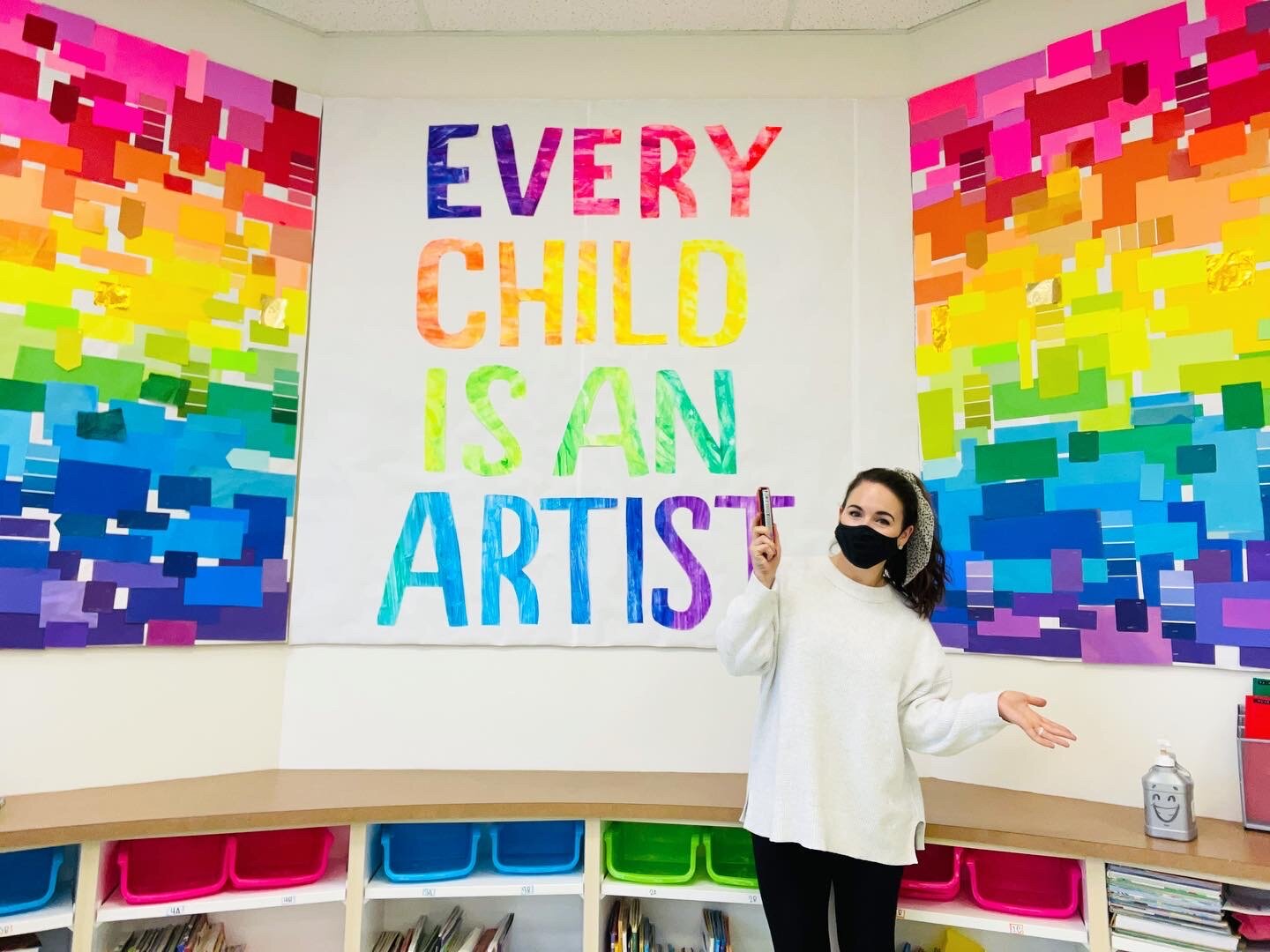
To be honest, my offset twelvemonth teaching- I spent way more time in my classroom then I did in my own house. Then I wanted to savor walking into my classroom every morning, and I wanted my students to WANT to be in my space. Now of course it'south not just your room and concrete environs that make your class special- it's YOU, their amazing teacher! All the same, equally artists, we are inspired past things that we run into! Consider aesthetics and how you can create a space that is warm and fun and an exciting place your students will want to come! Not every teacher feels that rainbows and brilliant colors are their cup of tea- but other things you lot can consider adding to your space is accent lighting (table lamps, cafe lights, etc…) greenery (helloooo beautiful little business firm plants to add warmth!) and possibly even a water characteristic! 1 year when I was teaching in a mobile classroom, I bought a small table fountain from Lowes and it was hands my students' favorite affair in that infinite! Be true to yourself when decorating your classroom. What are y'all drawn to? What practise you lot think your students similar to meet? For me, I exercise love color, and so I opted to create my visuals using bright colors, but with a clean modern touch on (specifically my elements and principles of art and my famous creative person wall). Y'all could think nearly calculation a statement wall or mural to your room if you lot're feeling fancy, but certainly do not put that kind of pressure on yourself right out of the gate.
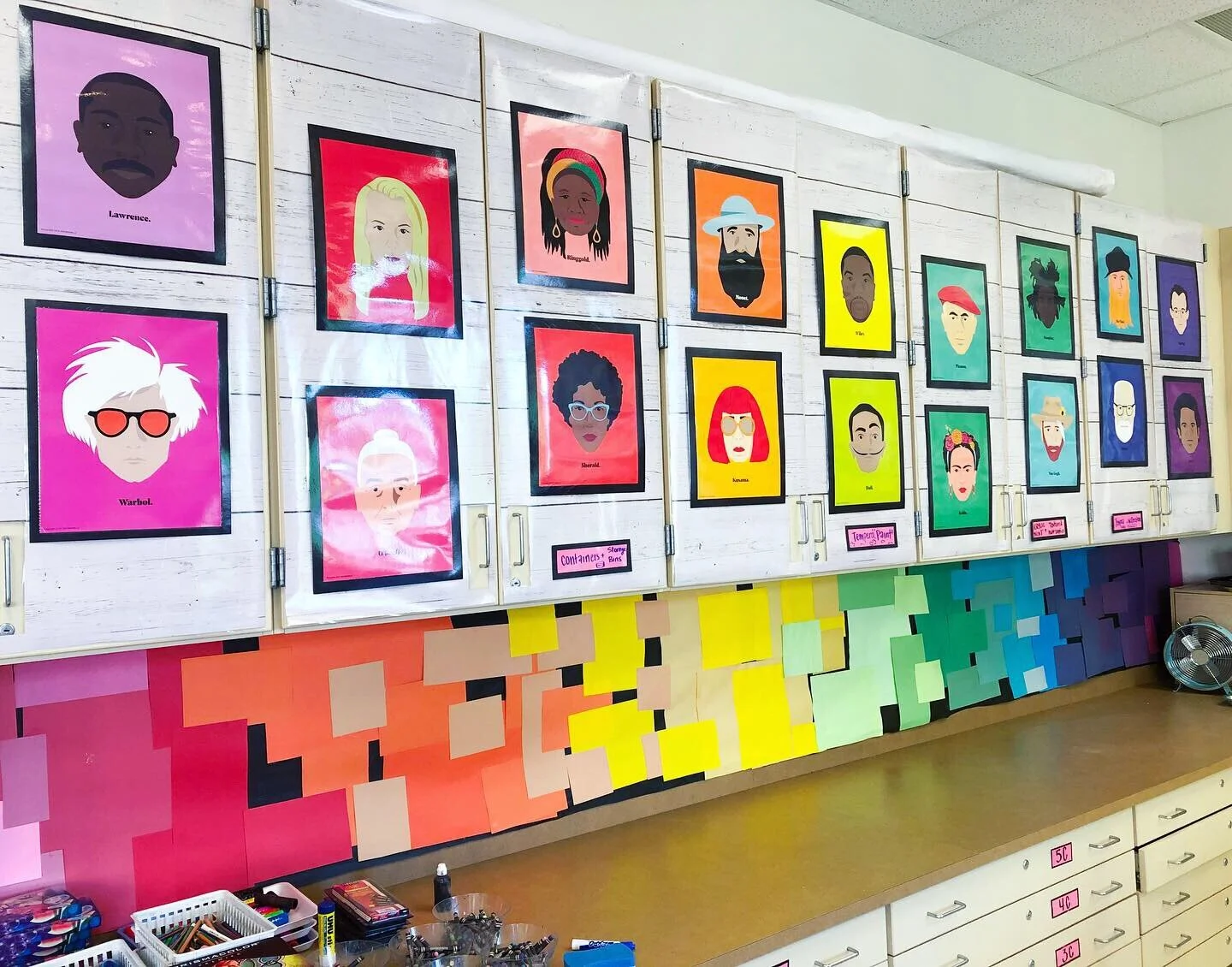
vii. Share Bits of Your Personality
One fashion that I testify some of my personality in my classroom is with one word: Personification. Seriously, I know it's silly but there's goose egg kids honey more than than give-and-take bubbling and crazy googly eyes. Giving inanimate objects in your room a personality is a fun style to engage students and still share valuable information with them. In that location'south just something about an old paintbrush with crazy optics on information technology that helps teach kids about the correct style to care for a paintbrush.
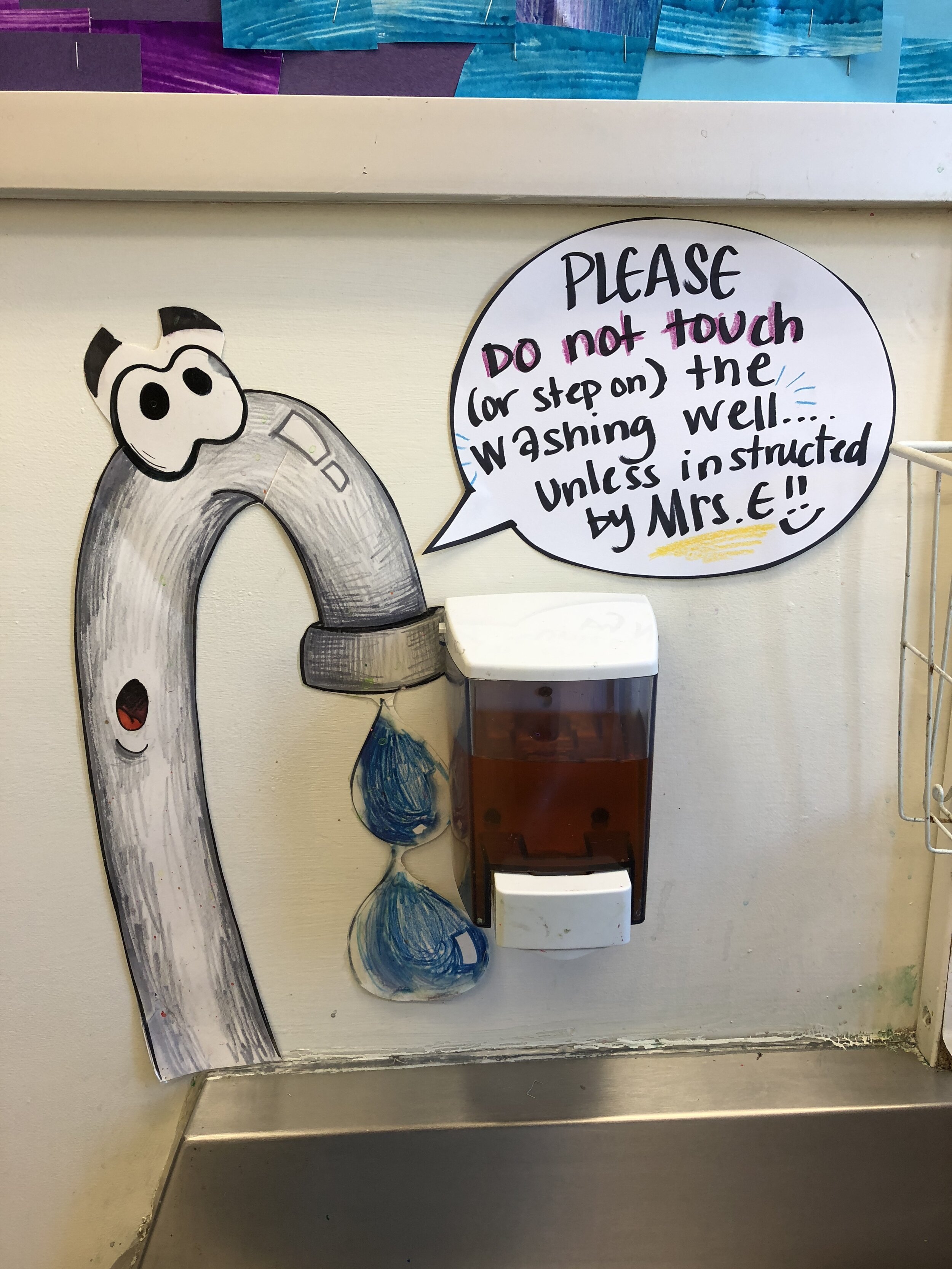
If the giddy route isn't your thing, that'south ok! Just don't exist agape to share bits of who you are either through your visuals, the style of your room, or even through displaying your own fine art! Prove off your amazing artistic skills by displaying some of your own art so that students tin can also see you as a practicing artist!
viii. Build Relationships First…
As Kayla Dornfeld says "Relationships start, everything else 2nd". This statement could not exist more true. Don't stress over what it is you lot volition be educational activity your students the first or even second week of school, the content is not important yet. What is of import is getting to know who your students are offset then that you can create quality lessons for them that meet their needs and skill level. Instead of jumping right into content, spend the first few weeks getting to know your students' personalities, interests, hobbies, etc through their fine art while too practicing those rules and procedures we talked near earlier. I of my favorite ways to get to know my students is by having my students design a cover for the sketchbooks nosotros create every year. Sketchbooks for students are a great way to provide a personal space for students to create, they are a safe place for practice and an amazing style to see growth. I could go on and on about why sketchbooks are an amazing tool for kids to have in the classroom, but yous can read more almost them here. I ask my students to design a embrace for their sketchbook that has a theme effectually something they are passionate almost. I love walking effectually the room request students about their work and learning more than most them, their hobbies, interests, etc. I am always blown away by how invested my students are when designing their sketchbooks and how attached to them the get by the finish of the year. Sketchbooks are merely one way you can become to know your students and begin building a rapport and mutual respect for one another that is sure to lead to a successful year.
Source: https://artwithmrse.com/blogs/blog/8-tips-to-setting-up-your-art-room
0 Response to "Where to Do You Store Art Projects Art Teacher"
Publicar un comentario