What Are the 6 Language Arts What Are the 6 Problem
roblem-solving might non be the kickoff thing you think of when y'all hear "language arts," but taking a problem-solving approach to reading and writing can be a powerful way to motivate students to desire to learn.

Problem-Solving isn't just a math matter.
Whenever we "do" language arts—in other words, any fourth dimension we read, write, speak, or interpret—we are problem solving. If you've ever researched a car earlier you purchased information technology, or seen through a politico's hedging, or tried to depict your symptoms to a doctor, you've solved a language arts problem.
Problem-solving in language arts means using linguistic communication skills to understand or communicate an idea: Is this automobile worth the money? What'south that guy's agenda? How tin I become my medico to sympathize what I'm experiencing? Past some combination of reading, writing, speaking, and interpretation, yous have probably solved thousands of linguistic communication arts problems in your lifetime.
But linguistic communication arts problems aren't just personal—they can happen on a large scale, and they can impact people in very real ways. Have medical brochures, for instance. In 2017, NPR reported on a problem that hospitals in the UK were experiencing. At the time, the average reading level in the Great britain was fourth grade, but most hospital literature was written at a twelfth-grade level. This meant that, if you needed hip-replacement surgery, your md was likely to hand you a brochure on par with Shakespeare or Dickens, when y'all were more comfortable reading Judy Blume. Granted, we tend to read at a college level when nosotros're reading something that is deeply interesting to u.s.a. (and what could be more interesting than your own impending surgery?), but asking patients to jump eight class levels to understand what was going to happen to them during surgery was a trouble—a language arts problem.
To detect new means of solving this problem, researchers recruited actual 4th-graders to take a crevice at writing hip-replacement brochures. The students' brochures—equal parts adorable, strange, and honest—provided a totally new perspective on what hospital literature could expect like. Cartoon lessons from the fourth-graders, the researchers argued for more than honesty and simplicity in patient literature. In other words, the students' writing was a small but real step toward solving a real trouble.
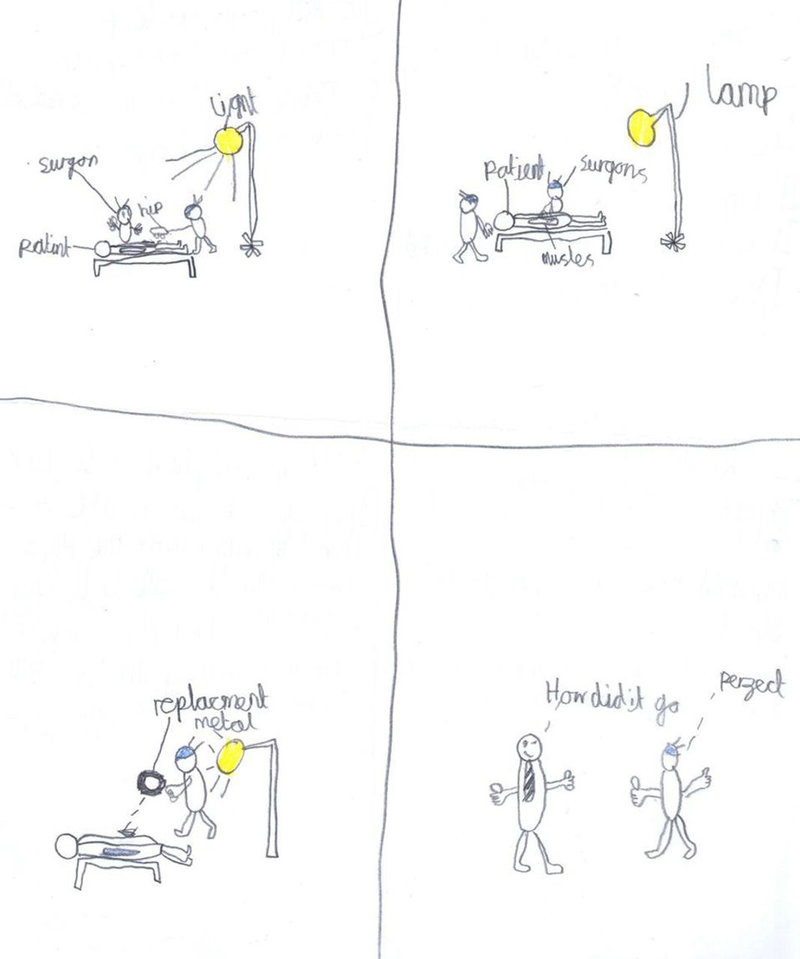
The infirmary problem crystallizes what we mean when nosotros say "language arts problem." For the hospitals, it was a writing problem—a need to communicate to patients in clear language, "Here'south what's going to happen to y'all." For the patients, it was a reading trouble—a demand to understand what was going to happen to their bodies. I love this example considering it shows both sides of a language arts problem: communicating (writing) and understanding (reading).
Any time we're trying to communicate or sympathize something by reading, writing, or speaking—and that'due south pretty much all the fourth dimension—we are solving a language arts problem.
Merely not all language arts problems are created equal. A practiced linguistic communication arts trouble, similar a skillful math problem, is one that really needs to be solved. In some cases, it literally needs to be solved—patients need to understand their surgeries, yous demand to know whether yous should buy that car or not. In other cases, a good linguistic communication arts problem is just too enticing to walk away from.
Remember almost the final time you read a really good novel. Call up how it felt to need to read on, to non want to put the book down because you just had to know what would happen next? That's how a good language arts problem feels.
That's how students should experience linguistic communication arts, likewise—and they tin.
Past building problem-solving into language arts curriculum, we can turn ELA subjects like reading, writing, speaking, estimation—even grammar—into compelling problems that demand solutions.
Imagine how those fourth-graders must have felt when existent researchers approached them and said, "We have these patients who actually need to empathise the surgeries they're about to have, but the brochures we wrote are confusing. You're actually expert at writing in a way that our patients tin can empathize. Tin can you aid?"
It's hard to say no to a asking like that.
That'southward considering the proposal doesn't feel like an assignment—it feels like a mission. Students tin clearly see the problem, they can run into why they demand to solve it, and there isn't already an obvious solution. Moreover, past solving the problem, students are creating a slice of writing that people actually need. In other words, with problem-solving, students aren't practicing reading and writing skills for the sake of practice—they're using reading and writing skills to make something that needs to exist.
Every lesson students encounter in language arts should experience like this. The challenge is to engineer a curriculum that has problem-solving built in at every plow. This is no small task, specially when you lot consider the breadth of linguistic communication arts pedagogy. How practice you build problems that make students need to learn grammar? To master academic writing? To read nonfiction? How do yous get students to really, genuinely demand to remember critically near data they encounter exterior of school? In other words:
How practice yous create truly compelling bug that help students develop skills across the broad spectrum of language arts?
This is a question we've been grappling with every bit we build a language arts curriculum at AoPS. In that location is no formula for a really dandy linguistic communication arts problem. (And, actually, part of the fun of problem-solving is figuring out lots of artistic approaches—even when the problem y'all're trying to solve is how to make a good trouble.) But, by working closely with students and teachers, collaborating with our math colleagues, and looking to models like the hospital problem, nosotros have developed a few big ideas that are guiding the curriculum we're building.
These ideas are the foundation of our Animal University Language Arts books, and we think they tin can help anyone who is interested in engineering good language arts bug for students.
one. Make it a trouble, not a prompt
A prompt is an assignment: Create an informational brochure about a medical topic. Enquiry a sea animal and write an essay that teaches readers nigh your animate being. Write a story most a time you stood upwardly for an idea. A educatee's motivation to answer to a prompt comes mainly from outside the prompt itself. You answer to a prompt considering information technology's required—it's an assignment. Some prompts are interesting or fun, and many younger students are happy to consummate assignments because they want to be good students. That's great, merely it's incidental to the prompt itself: a prompt starts from the assumption that students are going to practice the assignment—information technology doesn't exercise the work of getting students to the table.
A trouble, on the other hand, starts from motivation. When you're designing a problem, the first question you accept to inquire—and go along asking—is, "What makes a student desire to exercise this?"
There are many ways to create motivation. Motivation could come from the intriguing nature of the trouble itself, every bit with a good word puzzle or a really provocative question. Or, motivation could come from a well-crafted scenario—a writing project that's built similar a cull-your-own-adventure novel, or a grammar lesson framed every bit an escape room. If you're working direct with students, you can create motivation by letting your students cull their own problems to solve, as in this compelling case study where seventh-graders took on child labor in their community and developed a range of skills—nonfiction reading, online research, analyzing and synthesizing multiple sources, public speaking, academic writing, and more than—in the service of solving a problem they really cared about.
In curt, creating motivation means never assuming that students will want to do something just because it'southward an assignment. Good language arts problems come up from a process of recognizing and rooting out this assumption at every plough.
ii. Allow reading, writing, grammar, and vocabulary work together.
We often call up of language arts as a set of subjects, each with its own chunk of class time. In an uncomplicated classroom, students might spend a chunk of time reading independently, another chunk doing online inquiry for a writing project, some other chunk reading nonfiction, and some other chunk listening to their teacher read an authentic text like a novel or a collection of stories. Often, these split up chunks of fourth dimension are devoted to separate projects: we're researching and writing virtually body of water animals, and and then we're reading fables; we're learning how to read subtitles in an commodity well-nigh weather, and then we're writing personal narratives. This variety tin can be a good matter—if y'all're not jazzed about weather, at to the lowest degree that'south simply i part of what you're doing that 24-hour interval. Just variety can likewise erase opportunities to create motivation.
Have the student who's non interested in weather. She might be deeply invested in the other chunks of the day, simply there's little to motivate her to engage with the weather article, so she's less likely to connect with the lesson about subtitles. What if, instead of treating it as its own chunk, we embedded the weather article in a larger problem that integrated all of the language arts chunks for that day?
Here'south how a trouble like that might await in a classroom. Imagine that this is a cake of almost two hours in a third-course classroom, with students transitioning betwixt contained piece of work, grouping work, and class give-and-take as they motility through the problem. The block begins with an contained-reading warm-up, and the problem is introduced in step two:
- Independent reading (15 minutes): In this unit, we're learning about mythology. Find a reading spot in the classroom, and continue reading the book you have called from our mythology and aboriginal history library.
- Class read-aloud (10 minutes): Gather on the rug to hear the adjacent installment of our adventure story. Today, we observe out that Zeus has gone hole-and-corner. We need to find him earlier he hurts someone! He's hiding out somewhere in North America, but in that location's one style to figure out where he is: as the god of lightning, he tin't assist only attract unusual weather condition wherever he goes. Find the weird conditions, and you'll find Zeus.
- Nonfiction text practice (15 minutes): Hither are 2 texts. One is a page from a reference volume describing typical weather patterns in North America; the other is a page from a website that shows the weather in North America last week. Get back to your desk-bound, and work with your group to compare both texts to find out where Zeus is hiding. Ane thing before you lot go: we demand to work quickly to find Zeus before someone gets hurt—here's how you tin use subtitles to efficiently navigate these ii texts. Okay, go!
- Share and check (10 minutes): Time'southward up! Who figured out where Zeus is hiding? Which group wants to share where you lot recall he is and explain how you figured information technology out?
- Writing (xx minutes): Now, yous'll work independently. Write a acceleration that will be read on the news in the surface area where Zeus is hiding. It's really important to be clear in your acceleration—you've got to convince the people who hear information technology that Zeus is definitely in their region and urge them to go out, fast. If they don't sympathise you lot or if they recall y'all're incorrect, they might not go out, and that could be unsafe for them. Get in really articulate in your first sentence that Zeus is in their region, then give a couple more sentences to show them how you used weather patterns in the ii texts you examined to figure this out. 1 tip: remember how nosotros learned yesterday that "because" and "so" can help united states of america bring together clauses in a sentence? Those words might be helpful tools for you. Okay, go!
- Share and check (x minutes): Who wants to volunteer to share what they wrote? Class, imagine if yous were the people this student is trying to warn. What in their dispatch would convince you that you need to mind their warning?
- Class read-aloud (15 minutes): Nice work! Come back to the carpet and we'll go on reading our form book, D'Aulaires' Volume of Norse Myths. Today nosotros're reading about Odin. As we read, let's recollect about how Odin compares to Zeus.
When information technology's integrated into a larger problem-solving activity like this, the weather text feels a lot more relevant. The trouble—We need to find Zeus earlier someone gets hurt!—provides motivation for deciphering the weather commodity, and the nonfiction text feature we fix out to teach (subtitles) becomes a helpful and necessary tool for solving the problem. The problem also motivates the day'south writing and grammar practice, and the whole lesson is bookended by readings that accept students deeper into the world where the problem is rooted.
Put more broadly, integrating multiple linguistic communication arts skills into a single trouble creates motivation: it gives students a reason to demand to learn each skill. We need subtitles to find Zeus quickly; we need conjunctions ("because" and "so") to make our warning clear for the people who are in danger; we need to cite evidence to convince those people to go out of Zeus'south way. Practicing whatever one of these skills by itself tin feel tiresome and unmoored from how linguistic communication really works; practicing all of them together in the context of an engaging problem makes each skill feel relevant and of import.
3. Think large.
A lot goes into building a lesson like the Zeus problem. Beyond inventing the problem itself, you have to gather only the right texts for each stage of the trouble. Some of those texts need to be authentic literature—for example, the contained reading at the very beginning, and the grade reading at the terminate. You'll also need 2 nonfiction texts well-nigh atmospheric condition that volition line up in a way that suggests where Zeus is hiding. And those two texts demand to lend themselves to teaching subtitles. And they should exist engaging. And one should be an online source while the other is a print source. Actually, in that location's a good chance you'll need to write those texts yourself. On meridian of all this, students demand to accept been practicing persuasive writing just before you get to this lesson, and they need to have just learned "because" and "so" so that they tin can employ those skills when they write their dispatches. Oh, you'll also need to write a story that sets up the whole Zeus-is-hiding-quick-let'southward-find-him scenario.
All of this may sound daunting. If you're genu-deep in pedagogy your own classroom, pulling off a problem similar this might actually be impossible. Building problems that knit together multiple language arts skills in engaging and meaningful ways is like assembling a x-m-piece puzzle: you really need to run across the whole picture before y'all can start putting the private pieces together. But, with time, resources, expertise, and conscientious big-motion picture planning, a team of curriculum developers can build not just one lesson like this just entire form levels of lessons that accept problem solving built-in.
That'due south exactly what AoPS'south linguistic communication arts team is doing right at present, as we're creating our Beast Academy Language Arts curriculum. We are teachers, writers, and problem solvers ourselves, and—only as AoPS has done for math—nosotros are creating the curriculum we wish we'd had when we were in schoolhouse. We've already launched a pilot of our third-class Beast Academy Language Arts curriculum at AoPS Academy, and nosotros're hard at work refining this pilot and developing our third-grade guide and practice books (including some new teachers who will be joining the faculty at Beast Academy—that's Professor Isabella Bird, Beast Academy's resident archaeologist and librarian, at the top of this article).
Building this curriculum is our own, rather massive language arts problem. Like any skillful language arts trouble, it doesn't accept an obvious solution, so it will take some time for united states of america to produce our books. But, when nosotros do, we are confident that we are making something that really needs to exist.
Problem-solving might non be the kickoff matter yous think of when you hear "language arts," but taking a problem-solving approach to reading and writing tin be a powerful mode to motivate students to want to acquire.
Source: https://artofproblemsolving.com/blog/articles/a-problem-solving-approach-to-language-arts
0 Response to "What Are the 6 Language Arts What Are the 6 Problem"
Publicar un comentario